


Need, want, and pain are often used in the same sentence when talking about marketing. I get the impression executives believe the terms are one thing; they’re not.
Need, want, and pain are not interchangeable. They are distinctly different and, depending on which one your audience is feeling, they require a specific sales or marketing treatment.
Need is an urgent desire. For example, I need some petrol for my car.
Want is aspirational. Example, I’d like a better car.
Pain is solving a problem, e.g. my car keeps breaking down.
Understanding what is motivating your audience should influence your messaging and planned activity. Here is how I see it working…
The customer has a need
Needs are urgent; “I have to fill up my car!”. Therefore, your marketing is all about timing – being in the right place at the right time.
Re-marketing and programmatic marketing can play a role here, ensuring your online display adverts are promoted to people that have previously visited your website. Always being visible and therefore, front-of-mind when they need you.
Success may not be judged by the number of clicks on those advertisements, but by how frequently they are displayed. The term ‘impression’ refers to each time your advert is delivered to a potential customer – and impressions equal visibility.
The customer has a want
Wants are aspirational, as such they apply to both potential customers and existing customers. A potential customer may want to upgrade from a Fiat 500 to a BMW 5 Series.
For existing customers, there may be an opportunity to upsell. Persuading a BMW 3 Series customer about the benefits of the 5 Series.
The need may not be urgent, so nurturing would probably play a part. Multiple contact points (email, telephone, event invitations, etc.) over a period of time have proven to be successful in nurturing programmes. Add variety to the marketing channels you use to minimise saturation (and unsubscribes/disengagement).
Aspirations are not always cheap, so giving the customer time to save a deposit or offering low-cost finance can be a winner. But some nurturing programmes forget the golden rule – you are not keeping in contact to be nice, you are there to sell. Ask for an order.
The customer has a pain
Pains cause frustration. So a customer may initially contact you in a bad mood – ensure your team appreciate the customer’s frame of mind. But if you solve their pain, they will be delighted and are far more likely to recommend you to friends, family and colleagues.
To solve their pain, customers will probably look for a solution on a search engine. SEO should be a key factor in your plan, but be smart about the words and phrases you choose to be your goal.
It’s not about what you would search for to find a solution, it’s about the words and phrases your audience would use (two completely different things, you are not the audience).
Which is the greatest motivator? Need, want or pain?
This is a tricky question to answer. But understanding if your customers are more likely to be motivated by need, want or pain can be crucial. So I decided to conduct a poll on Twitter. The results are in the chart below.
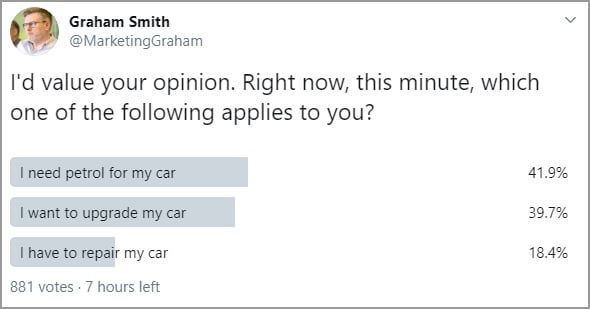
Over 800 people responded to the research and I find the results fascinating and logical.
Needs and wants score well against pain, and that makes sense. We are far more likely to have needs and wants than pains. Pains occur less frequently.
So does that mean we should build a marketing plan based solely on needs and wants? Not necessarily. I have already argued that solving a person’s pain will build greater loyalty to your organisation. A need can be temporary and a want loses satisfaction over a period of time.
The real answer is to build a marketing plan that delivers answers to all three. But don’t assume you are talking to three different types of people, one person can have all three desires.
Product development has a role to play here, so that one person can use your product to satisfy their need, want, and pain. For example, a car manufacturer that fills your car with petrol at home (need), as well as upgrading your car after a 3-year lease (want) and replaces it in 4 hours if it develops a fault (pain).
Analysis of your audiences’ desires plays an important part in developing your marketing plan and strategy. You can learn more in my article ‘Get started on your B2B marketing plan & strategy‘.